
From STEM to STREAM: The Critical Role of the Arts in Trinidad and Tobago’s Economic Diversification
From STEM to STREAM: The Critical Role of the Arts in Trinidad and Tobago’s Economic Diversification
Written: Seth Escalante
Published: 5th April 2026
Introduction
Trinidad and Tobago (T&T) stands at a critical macroeconomic juncture in 2026. With local financial institutions and international observers consistently highlighting the urgent need to sustain growth in the non-energy sector, economic diversification is no longer just a strategic aspiration—it is a national mandate (First Citizens Group, 2025; International Monetary Fund, 2026). To build this agile, diversified workforce, our educational frameworks are rapidly evolving. Historically, STEM (Science, Technology, Engineering, and Mathematics) education was the gold standard for developing technical competencies; however, modern academic research demonstrates that pure technical proficiency is insufficient to meet the complex problem-solving and innovation demands of the 21st-century economy (Nguyen et al., 2021).
Consequently, there has been a documented global paradigm shift toward STEAM, adding the "Arts" to cultivate divergent thinking, collaboration, and empathy alongside analytical skills (Gavrilas & Kotsis, 2025). Today, this framework has expanded further into STREAM—incorporating "Research" (and reflective reading/writing)—an acknowledgment that technical skills alone cannot drive innovation in a post-oil economy; rather, true economic agility requires holistic, interdisciplinary thinking (Gavrilas & Kotsis, 2025; Nguyen et al., 2021).
The Current STREAM Landscape in T&T
Initiatives championed by the National Institute of Higher Education, Research, Science and Technology (NIHERST) and Shell T&T Limited, such as the 2025/2026 Shell NXplorers Programme, are leading this educational charge. These programs empower students to tackle complex global challenges using STREAM principles which means approaching a problem with the analytical rigor of a scientist, the foresight of a researcher, the execution of an engineer, and the empathy of an artist.
This intersection of corporate investment and the arts is already deeply embedded in T&T’s cultural fabric. For decades, corporate entities have heavily sponsored the nation’s premier steel pan bands—such as BP Renegades, Massy Trinidad All Stars, and Republic Bank Exodus. These sponsorships are not merely philanthropic public relations; they are direct investments in community organizational structures, youth discipline, and the creative economy, recognizing that the arts build cohesive, highly coordinated teams capable of executing complex projects under pressure (Dudley, 2008).
Yet, within the formal classroom, the "Arts" component of STREAM is frequently misunderstood and its broader integration often causes tension in educational planning (Carter et al., 2021). Rather than being recognized as a core driver of modern economic strategy and cognitive competency, arts education is too often marginalized and viewed as merely a passive or extracurricular outlet (Schneider & Rohmann, 2021).
The "A" in STREAM: A Catalyst for Holistic Development
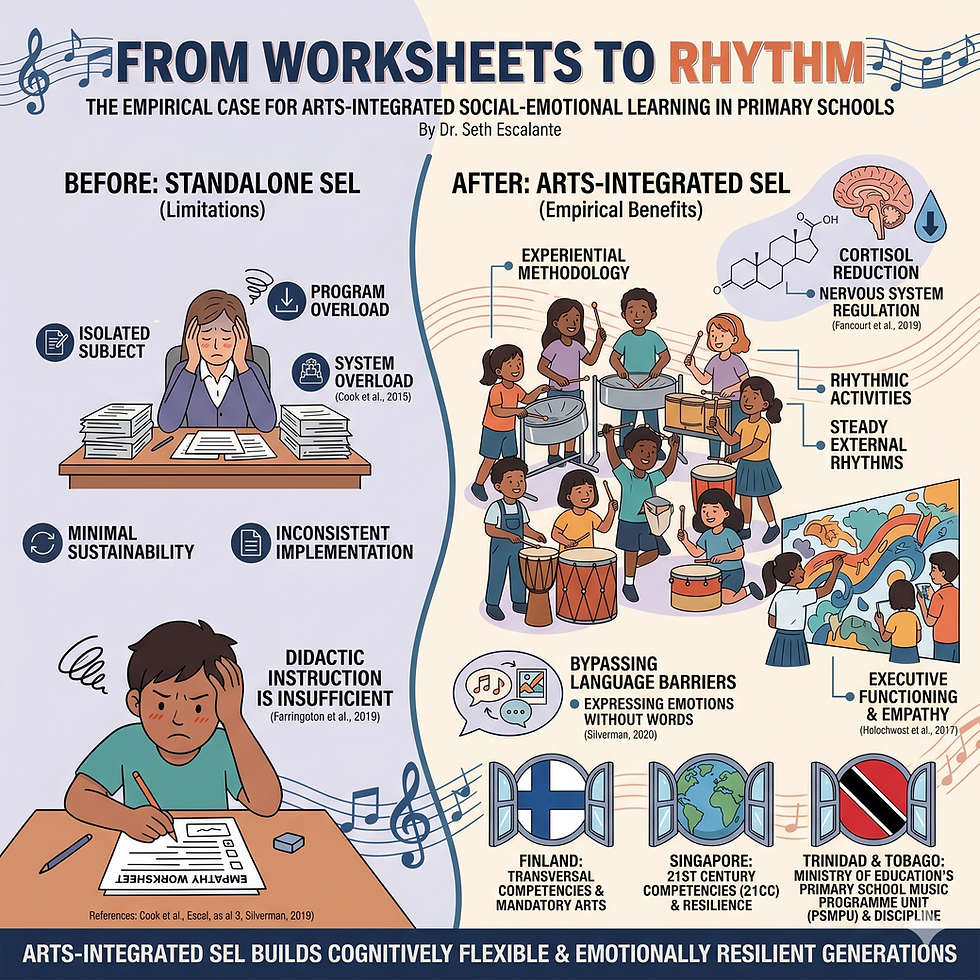
While my own experience supervising over 80 music instructors in over 300 primary schools and developing pedagogical training programs within the Ministry of Education, this has shown me the practical benefits of music in the classroom, the academic consensus on arts education is undeniable.
Research consistently demonstrates that arts integration is fundamental to a holistic education, producing well-rounded citizens equipped for the modern workforce. Students engaged in the arts exhibit higher levels of social-emotional development, increased school engagement, and superior executive functioning (Bowen & Kisida, 2019). The arts cultivate cognitive flexibility—the ability to view problems from multiple perspectives—which is a distinct economic benefit in a landscape where routine tasks are increasingly automated.
Why Business Leaders and Policymakers Must Champion the Arts
The non-energy sector in T&T—spanning manufacturing, digital technology, tourism, and services—requires a workforce that can navigate ambiguity. However, business leaders cannot achieve this alone; the government must play an equally critical role by fully integrating the arts at the foundational levels of our education system. Here is how the Arts in STREAM directly fuels corporate agility, and why early government intervention is essential:
Empathy and Human-Centric Design: The arts require deep emotional intelligence and the ability to view the world through the audience's eyes. In the corporate sector, this translates to "Design Thinking"—a framework that prioritizes human empathy (Brown, 2008). As T&T seeks to expand its digital service sectors and tourism, empathy is critical. A software developer must understand user-centric UI/UX design, and a hospitality manager must map out an empathetic customer journey. Without the emotional intelligence fostered by the arts, products and services risk becoming sterile and disconnected from consumer needs.
Resilience vs. AI Dependency: Contemporary educational systems are currently facing an educational crisis where students, heavily reliant on generative AI and digital tech, are becoming accustomed to instant answers, reducing their tolerance for cognitive struggle (Lodge et al., 2023). The arts provide the ultimate antidote. Preparing for a high-stakes musical performance requires rigorous, repetitive practice, real-time adjustment, and learning from failure. You cannot prompt an AI to practice a violin concerto for you; it requires grit. This iterative process of failing, adjusting, and trying again builds a resilient mindset that mirrors the agile methodologies utilized in successful tech startups and modern project management.
Creative Problem Solving: According to the World Economic Forum (2023), creative thinking is now the fastest-growing core skill required by global employers. Musicians and artists are trained to improvise; in an ensemble, if a player misses a cue, the group must harmonize conflicting elements in real-time to save the performance. In business, this directly translates to organizational agility. When supply chains break down or market disruptions occur, companies need teams that can "improvise" innovative, out-of-the-box solutions rather than freezing when traditional operational frameworks fail.
The Government's Role in Early Intervention: While employing music teachers in secondary schools is beneficial, true cognitive and economic transformation requires the government to mandate and fund music education in primary and early childhood learning centers. Research demonstrates that children who begin learning music before the age of seven exhibit significantly greater neuroplasticity—the brain's ability to grow, adapt, and form new neural pathways (Tokidos, 2024). Music activates multiple areas of the brain simultaneously, strengthening the corpus callosum and improving communication between brain hemispheres (East End Arts Council, 2025). Furthermore, early childhood music education has been proven to enhance language acquisition, working memory, and spatial-temporal skills, which are the exact cognitive foundations required for advanced mathematics, engineering, and problem-solving later in life (Miracle Recreation, 2024). By funding primary school music programs, the government is not simply supporting culture; they are actively building the neurological infrastructure of our future workforce.
Conclusion
True economic diversification in Trinidad and Tobago cannot be achieved by merely producing more engineers and data scientists. We need holistic thinkers who can bridge the gap between technical execution and human experience. As curriculum developers and business leaders look toward the future, we must ensure that the "A" in STREAM is fully integrated into our national strategy. By investing in the arts, we are not just preserving our rich cultural heritage; we are actively engineering a more resilient, innovative, and diversified economy.
References
Bowen, D. H., & Kisida, B. (2019). Investigating causal effects of arts education experiences: Experimental evidence from Houston’s Arts Access Initiative. Research Evaluation, 28(4), 331-342. https://doi.org/10.1093/reseval/rvz026
Brown, T. (2008). Design thinking. Harvard Business Review, 86(6), 84-92.
Carter, C. E., Barnett, H., Burns, K., Cohen, N., Durall, E., Lordick, D., Nack, F., Newman, A., & Ussher, S. (2021). Defining STEAM approaches for higher education. European Journal of STEM Education, 6(1), 13. https://doi.org/10.20897/ejsteme/11354
Dudley, S. (2008). Music from behind the bridge: Steelband spirit and politics in Trinidad and Tobago. Oxford University Press.
East End Arts Council. (2025, March 5). Notes of growth: How music boosts brain development in children. https://eastendarts.org/music-and-brain-development-in-children/
First Citizens Group. (2025, October 13). Trinidad and Tobago's economic road ahead. First Citizens Group News & Insights.
Gavrilas, L., & Kotsis, K. T. (2025). The evolution of STEM education and the transition to STEAM/STREAM. Aquademia, 9(1), ep25002. https://doi.org/10.29333/aquademia/16313
International Monetary Fund. (2026, February 10). Trinidad and Tobago: Staff concluding statement of the 2026 Article IV mission. IMF.
Lodge, J. M., Thompson, K., & Corrin, L. (2023). Mapping out a research agenda for generative artificial intelligence in tertiary education. Australasian Journal of Educational Technology, 39(2), 1-16. https://doi.org/10.14742/ajet.8695
Miracle Recreation. (2024). Benefits of music education in early childhood. https://www.miracle-recreation.com/blog/music-education-in-early-childhood/
National Institute of Higher Education, Research, Science and Technology. (2025). Shell NXplorers programme. NIHERST Science Popularisation.
Nguyen, H. T. T., et al. (2021). The transformation from STEM to STREAM education at engineering and technology institutions of higher education. SHS Web of Conferences, 124, 07003.
Schneider, V., & Rohmann, A. (2021). Arts in education: A systematic review of competency outcomes in quasi-experimental and experimental studies. Frontiers in Psychology, 12, 623935. https://doi.org/10.3389/fpsyg.2021.623935
Tokidos. (2024, April 18). Learning music early: Good for the brain? https://tokidos.com/blogs/parenting/learning-music-early-good-for-the-brain
World Economic Forum. (2023, April 30). Future of jobs report 2023. https://www.weforum.org/publications/the-future-of-jobs-report-2023/
Comments