
From Worksheets to Rhythm: The Empirical Case for Arts-Integrated Social-Emotional Learning in Primary Schools
From Worksheets to Rhythm: The Empirical Case for Arts-Integrated Social-Emotional Learning in Primary Schools
Written: Dr. Seth Escalante
Published: 24th April 2026
Introduction
Before examining the evolution of emotional education, it is necessary to establish its foundational framework. The Collaborative for Academic, Social, and Emotional Learning (CASEL) defines Social-Emotional Learning (SEL) as the process through which individuals acquire the skills to manage emotions, set positive goals, show empathy, maintain relationships, and make responsible decisions (CASEL, 2020). In modern primary education, these core competencies are increasingly recognized not as secondary soft skills, but as the cognitive bedrock required for long-term academic and professional success.
The Empirical Limitations of Standalone SEL
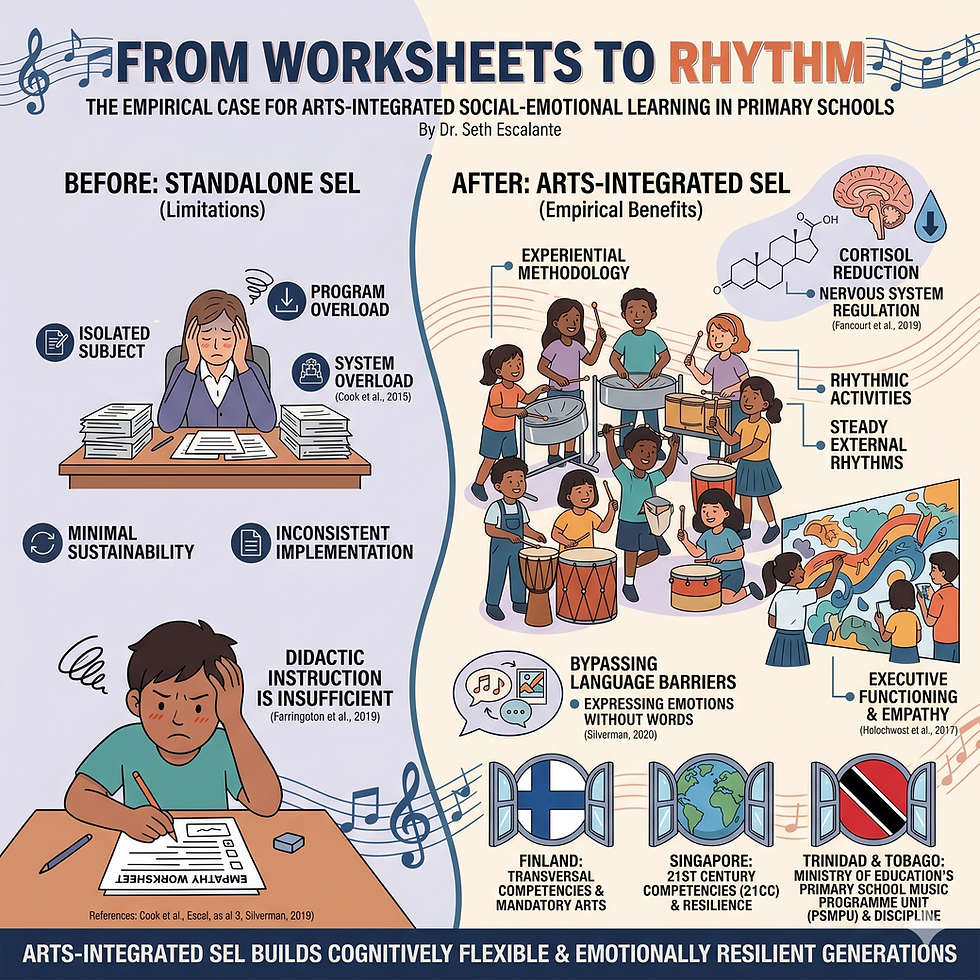
While the integration of SEL into school curricula is widely supported, research highlights significant limitations in how these programs are traditionally executed. Educational leaders frequently utilize "standalone" or direct-instruction SEL models, treating emotional intelligence as an isolated academic subject. A prominent example is the "Second Step" curriculum, a highly structured, lesson-based program utilized in over 45,000 schools globally, including large-scale adoptions by districts like Loudoun County Public Schools in Virginia (Committee for Children, 2024; LCPS, 2019). In this model, educators must carve out specific time blocks to explicitly teach isolated lessons on concepts like empathy.
However, studies indicate that this "program-for-every-problem" approach often causes "system overload" for educators, minimizing long-term sustainability (Cook et al., 2015). Because standalone programs require time outside of core academics, overwhelmed teachers experience severe implementation fatigue. Consequently, isolated SEL programs frequently report "null effects" across multiple behavioral domains; inconsistent implementation of these extra programs results in diminished or zero statistical behavioral improvements for participants (Cook et al., 2015; RTI International, 2022).
The fundamental limitation is cognitive: emotional regulation cannot be fully internalized through didactic instruction. When a child experiences acute frustration or anxiety, theoretical recall of a worksheet is insufficient; emotional regulation requires real-time, experiential practice.
Arts-Integrated SEL: An Experiential Methodology
To address the shortcomings of standalone models, researchers and policymakers explicitly advocate for the development of integrated models of school-based prevention (Cook et al., 2015). Arts-Integrated SEL embeds emotional and social objectives directly into creative processes, such as music, theater, and visual arts, bypassing the administrative overload of separate curricula entirely (Cook et al., 2015; Kennedy Center, 2024).
The primary distinction is experiential application. Rather than discussing resilience theoretically, a student experiences active frustration while attempting to master a complex rhythmic pattern or collaborate on a group mural (Farrington et al., 2019). The arts provide a safe, structured micro-environment where students can experience heightened emotions and be guided through active, physiological regulation (National Association for Music Education [NAfME], 2020).
The Neurological and Behavioral ROI
Empirical data demonstrates that integrating the arts into SEL yields significant cognitive and behavioral returns:
· Cortisol Reduction and Nervous System Regulation
o Neurological research indicates that engaging in rhythmic activities and shared musical experiences actively decreases levels of cortisol, the primary stress hormone (Fancourt et al., 2014). Steady external rhythms help synchronize the brain and regulate the nervous system, providing an immediate physiological grounding technique that allows students to decompress and shift focus (Thaut et al., 2015).
· Bypassing Language Barriers
o Traditional SEL relies heavily on verbal articulation (Collaborative for Academic, Social, and Emotional Learning [CASEL], 2020). However, young students, neurodivergent learners, or children experiencing trauma often lack the vocabulary to express complex feelings. Music provides an alternative communicative outlet, allowing students to process, identify, and express emotions safely without relying on verbal language (Koelsch, 2014; Silverman, 2020).
· Executive Functioning and Empathy
o Collaborative arts, such as playing in a musical ensemble or participating in theater, require advanced executive functioning. Students must practice inhibitory control (waiting for a cue), working memory, and cognitive flexibility (Holochwost et al., 2017). Additionally, participating in group music activities actively strengthens social bonds and fosters empathy, which is critical for positive peer interactions (Rabinowitch et al., 2013).
Global Applications of Arts-Integrated SEL
This experiential approach is actively utilized by forward-thinking educational frameworks globally:
· Finland
o Recognized for transformative educational models, Finnish curricula heavily intertwine "transversal competencies" (their framework for SEL) with mandatory arts and crafts, prioritizing creative expression and well-being over rigid standardized testing (Finnish National Board of Education, 2016; University of Helsinki, 2024).
· Singapore
o Through the Ministry of Education's 21st Century Competencies (21CC) framework, Singapore intentionally merges aesthetic appreciation with socio-emotional development, utilizing visual and performing arts to foster resilience, collaboration, and cross-cultural empathy (Ministry of Education Singapore, 2024; Setiawan, 2026).
· Trinidad and Tobago
o Locally, initiatives such as the Ministry of Education's Primary School Music Programme Unit (PSMPU) leverage cultural arts and ensemble music instruction to build discipline, community cohesion, and emotional regulation across primary schools (TTT News, 2025).
Conclusion
The competencies developed in primary school—resilience, empathy, and emotional regulation—are complex constructs that require active practice. By shifting pedagogical strategies from standalone SEL worksheets to Arts-Integrated SEL, educational institutions can prevent teacher burnout while utilizing proven neurological pathways to build a cognitively flexible and emotionally resilient generation.
References
Collaborative for Academic, Social, and Emotional Learning. (2020). CASEL guide to schoolwide social and emotional learning. https://casel.org/
Collaborative for Academic, Social, and Emotional Learning. (n.d.). Fundamentals of SEL. https://casel.org/fundamentals-of-sel/
Committee for Children. (2024). Second Step programs. https://www.secondstep.org/
Cook, C. R., Frye, M., Slemrod, T., Lyon, A. R., Renshaw, T. L., & Zhang, Y. (2015). An integrated approach to universal prevention: Independent and combined effects of PBIS and SEL on youths' mental health. School Psychology Quarterly, 30(2), 166–183. https://doi.org/10.1037/spq0000102
Farrington, C. A., Maurer, J., McBride, M. R. A., Nagaoka, J., Puller, J. S., Shewfelt, S., & Wright, L. (2019). Arts education and social-emotional learning outcomes among K–12 students: Developing a theory of action. University of Chicago Consortium on School Research.
Finnish National Board of Education. (2016). National core curriculum for basic education 2014.
Kennedy Center. (2024). What is arts integration? https://www.kennedy-center.org/education/resources-for-educators/classroom-resources/articles-and-how-tos/articles/collections/arts-integration-resources/what-is-arts-integration/
Loudoun County Public Schools. (2019). Social emotional learning in LCPS. https://www.lcps.org/domain/31411
Ministry of Education Singapore. (2024). 21st century competencies (21CC) framework and visual and performing arts. https://www.moe.gov.sg/
National Association for Music Education. (2020). Music education and social emotional learning. https://nafme.org/wp-content/uploads/2023/04/NAfME-SEL-Brochure-May-2020.pdf
Rabinowitch, T. C., Cross, I., & Burnard, P. (2013). Long-term musical group interaction has a positive influence on empathy in children. Psychology of Music, 41(4), 484-498. https://doi.org/10.1177/0305735612440609
RTI International. (2022). Social emotional learning programs for middle school: Developing evidence-based programs. https://www.rti.org/rti-press-publication/social-emotional-learning-middle-school-developing-evidence-based-programs
Setiawan, A. (2026). Transforming the arts education curriculum as a strategy for strengthening 21st-century competencies. Journal of Primary Education.
TTT News. (2025, July 8). Ministry of education hosts district music concerts. TTT Limited. https://www.ttt.live/ministry-of-education-hosts-district-music-concerts/
UNESCO. (2023). Arts for transformative education: A guide for teachers. UNESCO Digital Library. https://unesdoc.unesco.org/ark:/48223/pf0000382541
University of Helsinki. (2024). Preparing future teachers for social and emotional learning integration. Helda Digital Repository. https://helda.helsinki.fi/

Comments